
The Wisdom of Thinking in Gold: Why Family Offices Need a Second Ruler for Measuring Returns

Most family offices we know can tell you, to the basis point, what its U.S. equity book returned last year in dollars. Fewer can tell you what it returned in gold. That gap is not a rounding error: it is a blind spot, and it is about to matter a great deal more than it has in the last decade.
Ask any principal or CIO of a family office, especially those in the most developed countries, how their portfolio performed, and the answer arrives instantly, precisely, and in one currency: the one printed on the cash they spend, the school tuition they pay, and the statements they receive. That instinct is natural. It is also incomplete, and increasingly problematic to leave unexamined.
The Measurement Problem Nobody Questions
Modern portfolio reporting was built around a quiet assumption: that the home currency is a fixed, neutral ruler against which everything else is measured. For a U.S. family office, that means the dollar. For a family office in London, Zurich, or Singapore, it means the British pound, the Swiss franc, or the Singapore dollar. In every case, the assumption is the same: the currency itself doesn’t move; only the assets denominated in it do.
That assumption was reasonable enough in a world of low, stable inflation and a currency whose purchasing power eroded slowly and predictably. It becomes far less reasonable once the currency itself starts moving, and our research suggests it already has, in ways most performance reporting simply doesn’t capture.
We recently completed an analysis of S&P 500 performance across four time horizons: 10, 20, 30 and 40 years, measured not just in nominal U.S. dollars, but also in gold and in CPI-adjusted (inflation-adjusted) dollars. The findings should unsettle anyone who has only ever looked at the first of those three numbers.
A portfolio that looks flawless in dollars can be quietly losing a race against a harder currency, and almost no one is watching the scoreboard.
What Happens When You Change the Unit of Account
Priced in U.S. dollars, the S&P 500 has compounded at roughly 9.2% a year over the last 40 years, a figure so familiar it has become a kind of investment folklore, the number quoted in every pitch deck and pension assumption. Priced in gold instead, that same index has compounded at just 2.9% a year over the same period. Shorten the window, and the picture gets more uncomfortable, not less: over the last 30 years, the gold-denominated return is effectively flat. Over the last 20, it is mildly negative. Over the last 10, it is close to zero and falling.
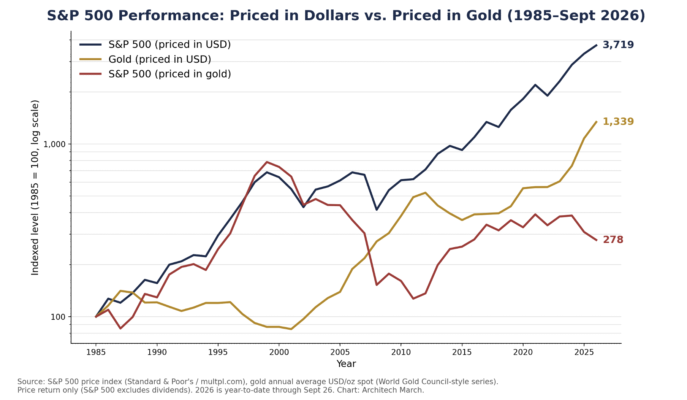
The S&P 500, indexed to 100 in 1985: priced in U.S. dollars (navy), gold priced in U.S. dollars (gold), and the S&P 500 priced in gold (red). Source: Architech March analysis, S&P Dow Jones Indices, LBMA-style gold data.
None of this means the S&P 500 has been a poor investment, far from it. Adjusted for CPI inflation rather than gold, real returns remain solidly positive across every horizon we tested, from roughly 5.2% to 9.5% a year. The point is narrower and, we think, more important: the S&P 500’s return relative to the dollar, relative to the cost of living, and relative to gold are three different numbers, and a family office that only ever looks at the first one is navigating with a third of the instrument panel covered up.
The most vivid illustration is also the most recent. Since January 1, 2022, period covering the fastest Federal Reserve hiking cycle in four decades, a sharp equity drawdown, an AI-driven recovery, and a historic gold rally, the S&P 500 has gained 62% in nominal dollars and 35% after CPI adjustment. Priced in gold, it has lost 31% of its value.
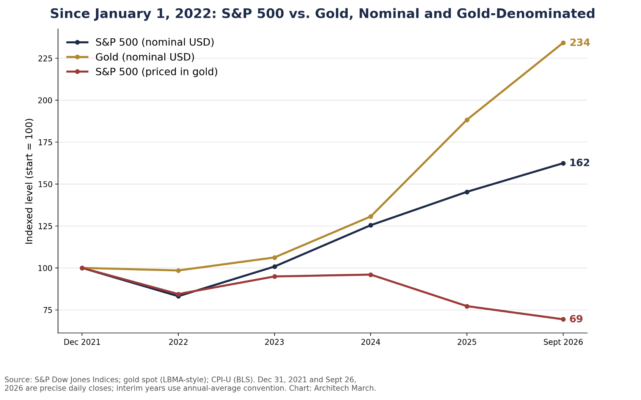
S&P 500 and gold since January 1, 2022, indexed to 100: nominal dollars, CPI-adjusted dollars, gold in dollars, and the S&P 500 priced in gold. Source: Architech March analysis.
A family office reviewing only the first figure would reasonably conclude the last four and a half years have been benign, even good. A family office also watching the third figure would recognize that a meaningful share of its real, hard-currency purchasing power has quietly slipped away, not because its managers did anything wrong, but because the yardstick itself moved.
Even From the Bottom of the Market, Gold Still Wins
A skeptic might reasonably object that January 2022 is a cherry-picked starting point. It captures the full pain of the 2022 bear market before the recovery began. So we ran the same analysis from the most flattering possible starting point for equities available in the current cycle: October 12, 2022, the S&P 500’s official bear-market trough, when the index closed at 3,577.03. If gold’s advantage were merely an artifact of a badly timed start date, it should disappear once equities are given credit for their entire subsequent recovery. It does not.
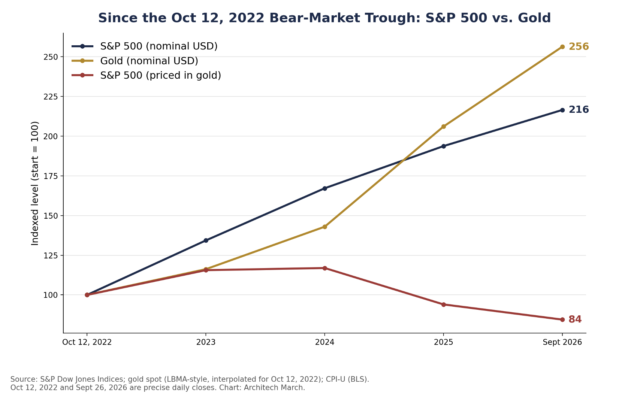
S&P 500 and gold since the October 12, 2022 bear-market trough, indexed to 100: nominal dollars, CPI-adjusted dollars, gold in dollars, and the S&P 500 priced in gold. Source: Architech March analysis.
From that exact bottom through September 2026 (roughly 3.96 years) the S&P 500 has delivered one of its strongest multi-year runs in decades: up 116% in nominal dollars, and still up a robust 93% after adjusting for inflation. By any conventional measure, this has been an exceptional bull market. Gold, over the identical stretch, is up 156% in nominal terms and 128% after inflation, more than 1.3 times the equity market’s real gain. Priced in gold, the S&P 500 is still down 15.5% since the exact day the bear market ended.
Give equities credit for the entire bull market, measured from the exact bottom, and gold still finishes ahead. That is not a story about a bad entry point. It is a story about which asset is actually winning.
The path is worth pausing on, because it is not a single smooth divergence. From the October 2022 trough through the end of 2024, equities actually kept pace with gold, the two moved together closely enough that a family office checking in at any point in that stretch would have seen little cause for concern in either direction. The entire gap opened in 2025 and 2026, as gold’s rally accelerated sharply while equities, though still rising, could not keep up. In other words: this is not old news baked into a stale historical average. It is a live, accelerating divergence that has opened up in the last eighteen months, arguably the most decision-relevant period for anyone reviewing an allocation today.
A Blind Spot Built Into the System
This is not a criticism of any individual family office, allocator, or reporting system. It is a structural feature of how performance measurement works almost everywhere in the developed world. Custodial statements, fund fact sheets, benchmark indices, and even most sophisticated attribution systems are built to answer one question: “how much of my home currency do I have now, compared to before?”, and are largely silent on a second, equally important one: “how much has my home currency itself been debased in the meantime?”
The result is a curious asymmetry. Family offices that would never evaluate a manager without adjusting for risk, leverage, or currency exposure in a foreign holding will often accept their own domestic-currency return as an unadjusted, final answer, without asking what it would look like priced in a currency nobody can print.
Why This Matters More From Here Than It Did Before
The case for watching a second currency has been building for years, but it has moved from academic to urgent for a specific reason: the scale of developed-world sovereign debt now makes some form of currency debasement, whether through sustained above-target inflation, financial repression, or outright monetization,look less like a tail risk and more like a policy default option.
Governments facing debt burdens that are difficult to service through growth or taxation alone have historically reached for the same lever: expand the money supply, let inflation quietly erode the real value of what is owed, and let bondholders and cash-holders, not elected officials, absorb the cost. This is not a prediction of any specific policy action; it is an observation about incentives, and about a pattern that has recurred across currencies and centuries whenever debt levels reached the point where the arithmetic of repayment stopped working cleanly.
If the debasement trade accelerates, the family offices still measuring success in the currency being debased will be the last to notice, and the first to ask why their multi-decade wealth plan quietly stopped compounding in real terms.
Gold is not the only lens through which to watch for this, but it is one of the oldest and cleanest: a monetary asset with no central bank, no policy discretion, and a multi-thousand-year track record as a unit of account independent of any single government’s balance sheet. Our analysis of the period since 2022 — in which gold has appreciated at roughly 19.7% a year in nominal terms and 15.1% a year even after CPI adjustment, more than double the S&P 500’s real return over the same window, and the even more striking result from the 2022 market bottom, is consistent with a market that is already pricing in some probability of this dynamic, whether or not it is being discussed at the family office investment committee table.
Thinking in More Than One Denomination
None of this is an argument for abandoning dollar-denominated reporting, market-timing a move into gold, or treating every allocation decision as a referendum on monetary policy. It is a narrower and more practical argument: that risk management and performance measurement should be conducted in more than one denomination, as a matter of routine discipline rather than occasional curiosity.
-
Add a second reporting currency to standing performance reviews: gold, a broad hard-asset basket, or a trade-weighted currency index, alongside, not instead of, the home-currency figure.
-
Distinguish explicitly between two different questions that are often conflated: “Is this portfolio beating inflation?” and “Is this portfolio preserving purchasing power against a monetary asset outside any government’s control?” Our research shows these can carry very different answers over the same period.
-
Revisit strategic allocations to gold and other hard assets not as a tactical hedge to be sized opportunistically, but as a structural position sized for an environment in which currency debasement risk is elevated relative to history.
-
Treat any historical equity risk premium derived from a 30- or 40-year lookback with some caution. Our data shows that a large share of the long-run “equities beat gold” result is concentrated in a single disinflationary regime (1985–1999) that has not recurred since, and may not recur on the same terms going forward.
-
Do not assume the current gap will close on its own the way it did after 2011. The divergence since the October 2022 low is a recent, accelerating phenomenon concentrated in the last eighteen months. Treat it as a live signal warranting a current review, not a historical curiosity to revisit later.
The Bottom Line
Family offices exist to preserve and grow wealth across generations, not across a single currency’s lifespan. A multi-generational mandate that measures itself in only one denomination is making an implicit bet that the denomination itself will hold still. History suggests that bet is not always a safe one to make quietly. As the pressures on developed-market currencies build, the families who ask the second question, not just “what did we earn,” but “what did we earn measured against something no government can create more of”, will be the ones who see the full picture in time to act on it, rather than explain it after the fact.
Author: Alex Tae Ho Kim
Architech March’s Value Creation Research team conducts ongoing analysis on multi-denominational performance measurement, monetary regime risk, and strategic asset allocation for family offices and private investment partners. To discuss how this framework applies to your portfolio, please contact your Architech March client relationship team.
This article is for informational purposes only and does not constitute investment, legal, or tax advice. Past performance is not indicative of future results. Architech March is not a registered investment adviser or broker-dealer.
Featured Insights
The Wisdom of Thinking in Gold: Why Family Offices Need a Second Ruler for Measuring Returns
Most family offices we know can tell you, to the basis point, what its U.S. equity book returned last year in dollars. Fewer can tell you what it returned in gold. That gap is not a rounding error: it is a blind spot, and it is about to matter a great deal more than it [...]

The Stranded Middle Market: Why Family Offices Are Positioned to Buy Private Equity’s Best Mid-Market Companies at a Discount
Situation Private equity has a backlog problem, and it is much larger than most outside the industry appreciate. By Bain & Company’s count, the global private equity industry entered mid-2026 holding roughly 32,000 unsold portfolio companies, an inventory of unrealized value approaching $3.8 trillion [i]. Hugh MacArthur, chairman of Bain’s Global Private Equity Practice, provided [...]

The Fragmentation Paradox: How Rational Decisions Create Structural Risk in Family Wealth Management
Introduction There is a paradox at the center of sophisticated wealth management that receives far less attention than it deserves. The decisions that build complexity into a family’s financial life are rarely mistakes. They are, in almost every case, individually rational: a new legal structure designed for tax efficiency, an additional jurisdiction selected for flexibility, [...]

As Empires Fall, Wealth Endures
Rome’s Lessons for Today’s Family Offices in an Era of Financial Uncertainty At Architech March, we are voracious readers of research, articles and all forms of content that can help us develop variant perception. Recently, one our Architech March Members came across this video called “When Rome’s Economy Collapsed, Only These 4 Assets Survived.” We [...]

Five Macro Shifts Redefining Global Capital
The Map Has Changed. Is Your Portfolio Still Reading the Old One? At Architech March, one of our core beliefs is that value creation demands variant perception – the ability to see the world as it is, not as it was. That’s exactly what Dr. Ilan Gildin, Founder & CEO, Emerging Markets Macro Strategies, delivered [...]